Graph Data Mining in the Age of LLMs
Graph data mining focuses on analyzing relationships between entities rather than treating data as isolated records. By representing data as nodes and edges, it enables the discovery of patterns within complex networks such as social graphs, transaction networks, and knowledge graphs. With the rise of Graph Neural Networks (GNNs), deep learning can now effectively model relational structures, improving tasks like node classification and link prediction. More recently, integrating large language models (LLMs) with graph mining has created hybrid systems that combine structural reasoning with semantic understanding. This approach enhances accuracy, interpretability, and insight extraction from both structured and textual data. As data becomes more connected and dynamic, graph mining—especially when combined with LLMs—plays a growing role in applications such as fraud detection, recommendation systems, and scientific discovery.
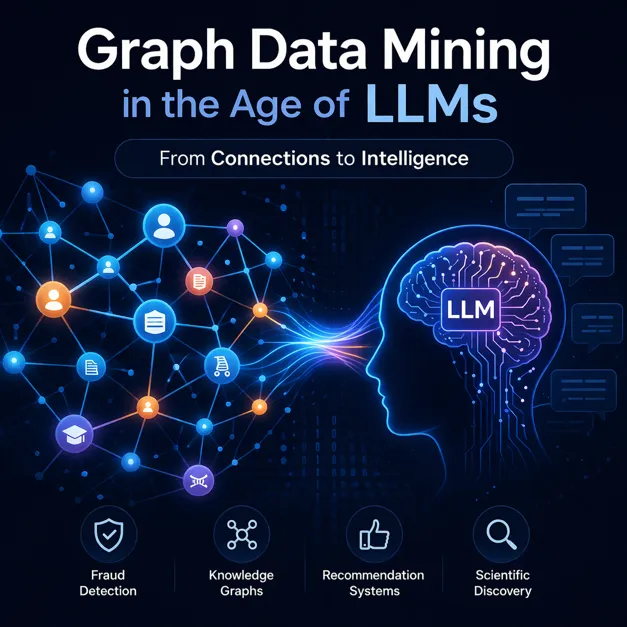
Graph Data Mining in the Age of LLMs: From Connections to Intelligence
For years, data mining has focused on rows and columns, structured datasets, where each record stands alone. But the real world is rarely independent. Customers influence each other, transactions form networks, and knowledge connects across domains.
This is where graph data mining comes in.
Now, with the rise of large language models (LLMs), graph mining is entering a new phase, one where structure meets semantics.
What Is Graph Data Mining?
Graph data mining focuses on extracting patterns from relational data, where entities are connected rather than isolated.
Instead of tables, data is represented as:
- Nodes (entities)
- Edges (relationships)
This allows us to analyze:
- Social networks
- Fraud rings
- Knowledge graphs
- Biological systems
Unlike traditional mining, graph mining captures context and interaction, not just attributes.
Why Graphs Are Becoming Central to Data Mining?
Modern data is increasingly:
- Connected (users, devices, systems)
- Dynamic (relationships evolve)
- Complex (multi-hop dependencies)
Traditional models struggle here.
Graph mining solves this by:
- Preserving relationships
- Enabling multi-hop reasoning
- Capturing hidden structures
For example:
- Fraud detection improves by analyzing transaction networks, not just individual transactions
- Recommendation systems improve by modeling user-item interaction graphs
The Rise of Graph Neural Networks (GNNs)
Graph Neural Networks extend deep learning to graph data.
They work by:
- Aggregating information from neighbors
- Learning representations based on structure
- Capturing both features and topology
This makes them powerful for:
- Node classification
- Link prediction
- Community detection
Recent advances show that GNN-based approaches significantly improve performance in relational tasks and large-scale networks
Where LLMs Enter the Picture?
A major recent trend is combining LLMs with graph mining.
Why?
Because:
- Graphs provide structure
- LLMs provide semantic understanding
Hybrid approach:
- Graph → “who is connected to whom”
- LLM → “what does it mean”
Recent research proposes LLM + GNN hybrid models that:
- Improve node classification accuracy
- Enhance interpretability
- Extract richer patterns from text + structure
Real-World Applications
1. Fraud Detection
Graph mining detects suspicious clusters of transactions rather than isolated anomalies.
2. Knowledge Graphs
Organizations build structured knowledge systems linking documents, users, and concepts.
3. Recommendation Systems
Graph-based embeddings capture deeper user preferences.
4. Scientific Discovery
Citation networks and research graphs reveal hidden knowledge relationships.
Challenges
Despite its power, graph data mining introduces new difficulties:
- Scalability → graphs can have billions of nodes
- Dynamic updates → edges change constantly
- Interpretability → deep graph models can still be opaque
- Integration with text/data modalities
These challenges are now active research areas.
The Future: Toward Connected Intelligence
We are moving toward systems that:
- Combine streams + graphs + representations
- Learn continuously
- Understand both structure and meaning
Graph mining is not replacing traditional data mining, it is extending it into a relational, dynamic, and intelligent paradigm. If you are interested in the topic you can also read “Large Language Models Meet Graph Neural Networks: A Perspective of Graph Mining” (2024). This paper shows taxonomy of LLM–GNN integration and demonstrates improvements in node classification & link prediction.