From AI Agents to Agentic Ecosystems: The Next Step in Intelligent Automation
AI automation is evolving from isolated agents and fixed workflows toward interoperable ecosystems of specialized AI agents. Learn how MCP and A2A enable agents to access tools, share information, collaborate across business processes, and support secure, scalable intelligent automation.
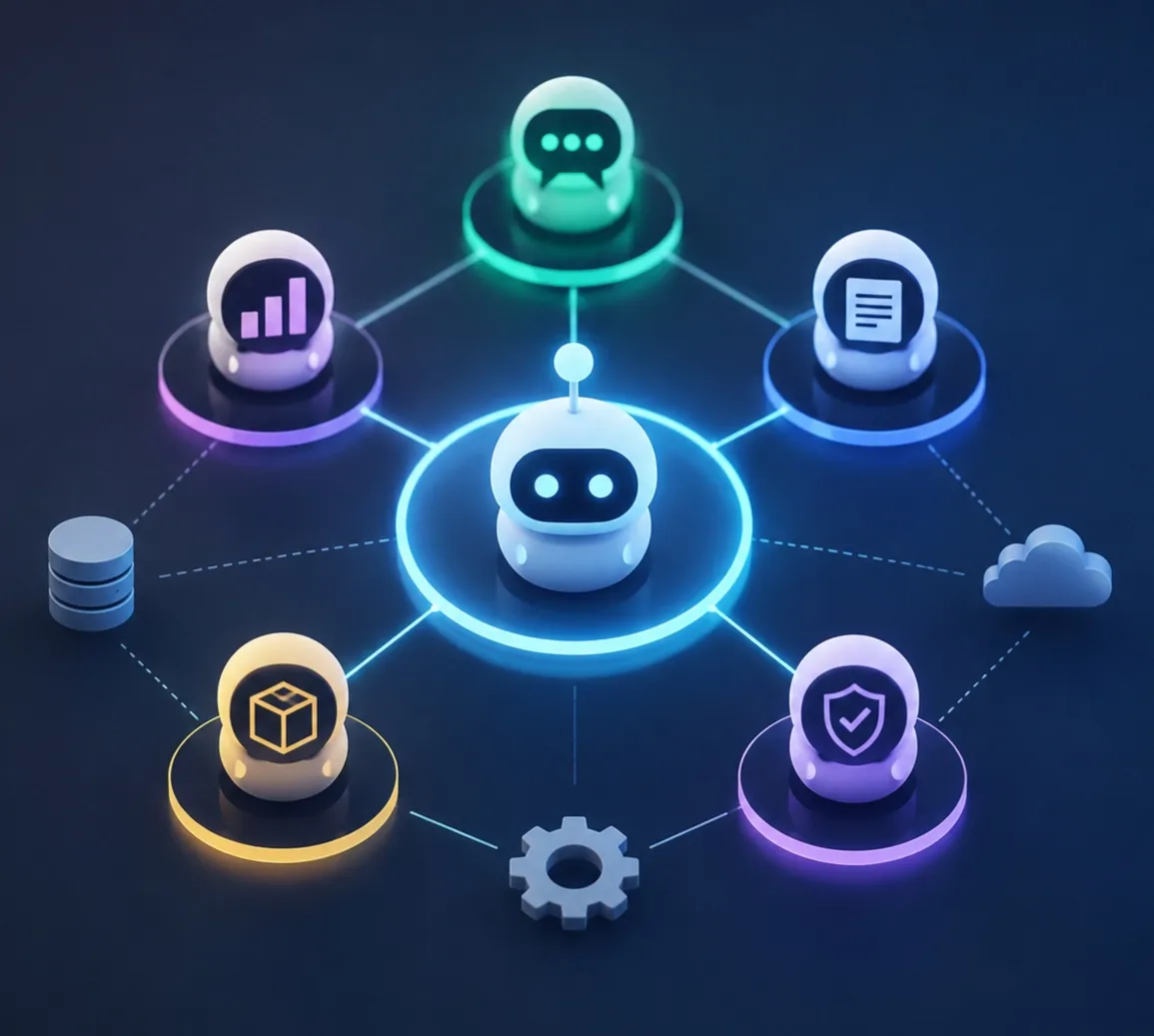
Artificial intelligence is moving beyond systems that simply answer questions or automate individual tasks. The next stage is an ecosystem where multiple AI agents can work together, access business data, use external tools, and hand tasks from one agent to another.
This shift is changing how organizations approach intelligent automation. Instead of building one AI system to handle an entire workflow, businesses can increasingly create networks of specialized agents that collaborate to achieve a common goal.
From Automation to AI Agents
Traditional automation generally follows predefined instructions:
- A trigger occurs.
- A fixed workflow starts.
- A predefined action is performed.
- The process ends.
AI agents introduce a different approach. An agent can interpret a goal, determine the steps required, use tools, and adapt its actions according to the information it receives.
For example, an AI-powered customer service workflow could involve an agent that understands a customer's request, retrieves information from a CRM, checks an order-management system, and escalates unusual cases to a human employee.
This is an important evolution from traditional automation and is closely connected to the concept of agentic hyperautomation, where AI agents become part of broader automated business processes.
But as organizations deploy more agents, a new challenge emerges:
How can different AI agents communicate and cooperate?
Why Agent Interoperability Matters
An enterprise might use different AI agents for different functions.
A financial agent could analyze transactions, another could manage customer information, and another could handle supply-chain operations. If these systems cannot communicate effectively, organizations end up building custom integrations between each system.
This can quickly become difficult to maintain.
Interoperability provides a different model:
Agents ↔ Standardized Interfaces ↔ Tools, Data, and Other Agents
The goal is to make agents less dependent on proprietary, one-off integrations.
MCP and A2A: Connecting the Agentic World
Two important developments illustrate this transition.
Model Context Protocol
The Model Context Protocol (MCP) is an open standard for connecting AI applications with external data sources and tools.
Instead of creating a custom integration for every AI application, developers can expose capabilities through a standardized interface.
This can allow AI systems to interact with:
- Databases
- APIs
- File systems
- Business applications
- Development tools
- Knowledge repositories
MCP therefore addresses an important question:
How does an AI application access the tools and information it needs?
Agent-to-Agent Communication
A2A (Agent2Agent) addresses a different problem: communication between independent AI agents.
Consider a procurement workflow.
A procurement agent receives a request for new equipment. It could then work with:
- A finance agent to verify the budget
- A supplier agent to compare offers
- A compliance agent to check purchasing policies
- A logistics agent to monitor delivery
Each agent specializes in a particular domain while collaborating with the others.
This creates a workflow that is less like a fixed automation pipeline and more like a network of specialized digital workers.
What Agentic Automation Could Look Like
Imagine a customer requests a refund.
Instead of a single automated workflow handling every possible situation, an agent could determine what needs to happen and coordinate with other systems. The agents can specialize in their own areas while the overall process remains coordinated.
This approach can be particularly valuable when business processes contain incomplete information, exceptions, or decisions that are difficult to represent with traditional rules.
Why Businesses Should Care
Interoperable agentic systems could provide several benefits.
Greater Flexibility
Organizations can introduce specialized agents without redesigning their entire automation platform.
Reusable Capabilities
An agent or tool can potentially serve multiple workflows rather than being tied to one application.
Faster Integration
Standardized protocols can reduce the amount of custom integration code required to connect AI systems with enterprise infrastructure.
Better Process Orchestration
Complex workflows can be divided into smaller capabilities and coordinated around a business goal.
Human Oversight
Agents do not have to operate completely autonomously. Sensitive or high-impact decisions can still be escalated to employees.
The Challenges
The rise of agentic ecosystems also introduces new challenges.
Security
An agent with access to business systems can perform real operations. Authentication, authorization, and controlled permissions therefore become essential.
Reliability
Multiple agents mean multiple potential points of failure. Organizations need monitoring, logging, validation, and recovery mechanisms.
Governance
Businesses need to understand which agent performed an action, what information it accessed, and what tools it used.
Cost
A single workflow may involve multiple model calls and external tools. Poorly designed agent architectures can therefore become expensive.
Human Control
Not every process should be fully autonomous. Financial transactions, regulatory decisions, and other high-impact operations may require explicit human approval.
From Intelligent Automation to Intelligent Ecosystems
The evolution of automation can be viewed as a progression:
RPA → Intelligent Automation → AI-Powered Automation → Agentic Automation → Interoperable Agentic Ecosystems
The final stage is significant because intelligence is no longer concentrated in one application.
Different agents can specialize, collaborate, and interact with an organization's existing digital infrastructure.
This creates a new vision for enterprise automation: not a collection of isolated automated processes, but a connected ecosystem of intelligent capabilities.
The Future of Intelligent Automation
The key question may no longer be:
“What task can we automate?”
Instead, organizations will increasingly ask:
“Which parts of this business process should be handled by rules, AI agents, humans, or a combination of all three?”
The goal of agentic automation is not necessarily to remove humans from every process. It is to allow software to handle more of the coordination, information gathering, and routine decision-making while humans remain responsible for judgment and oversight.
As standards for connecting AI systems, tools, and agents continue to mature, intelligent automation is moving toward a more connected architecture.
The future may therefore not belong to a single “super-agent.”
It may belong to ecosystems of specialized agents that can communicate, cooperate, and operate within secure and well-governed business processes.
For organizations investing in AI and automation, interoperability could become just as important as model intelligence.
The future of automation may not be one intelligent machine. It may be an intelligent network.