Causal Discovery vs. Correlation-Based Data Mining
Causal discovery goes beyond identifying statistical associations to investigate the underlying structures and possible causal relationships that generate observed patterns. This article explains the difference between correlation-based data mining and causal discovery, covering confounding variables, conditional independence, DAGs, major causal discovery methods, intervention-based reasoning, applications, and key challenges.
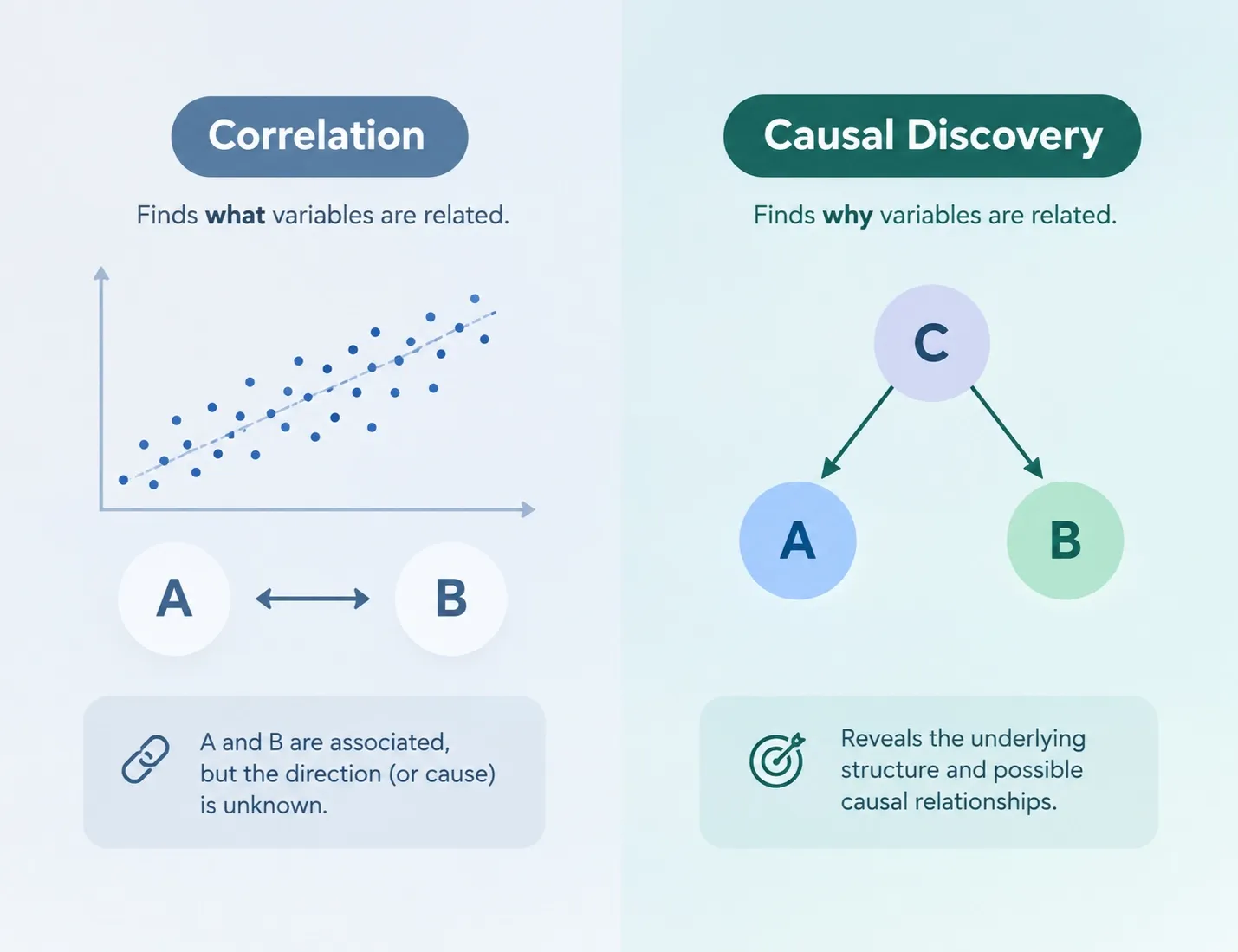
Data mining is often used to discover relationships between variables, but finding that two variables are related does not necessarily explain why they are related. Correlation-based methods can reveal strong associations and useful patterns, while causal discovery aims to investigate the underlying relationships that may generate those patterns. This distinction becomes increasingly important when data-mining is used not only for prediction, but also for understanding, intervention, and decision-making.
Causal Discovery vs. Correlation-Based Data Mining: From Patterns to Causes
Data mining has traditionally focused on finding patterns in data.
A dataset may show that two variables frequently change together, that certain events occur at the same time, or that one variable can be used to predict another. These relationships can be highly valuable for classification, forecasting, recommendation, and anomaly detection.
But there is an important question:
Does a relationship between two variables mean that one causes the other?
Not necessarily.
Correlation-based data mining identifies statistical relationships between variables. Causal discovery goes further by attempting to identify the underlying structure of relationships and determine which variables may directly influence others.
This distinction is changing how modern data mining approaches complex problems.
What Is Correlation-Based Data Mining?
Correlation measures the degree to which two variables are statistically associated.
For example, a dataset might show that:
- Advertising spending increases when sales increase
- Temperature rises when electricity consumption increases
- Website activity increases when purchases increase
These relationships can be useful for discovering patterns and building predictive models.
However, correlation alone does not establish the direction of a relationship.
Correlation-based mining is primarily concerned with identifying what variables are associated, rather than establishing why the association exists.
Why Correlation Is Not Enough
Consider two variables:
Ice cream sales and number of people swimming.
During summer, both may increase significantly.
A correlation-based analysis could correctly identify a strong relationship between them.
But increasing ice cream sales would not necessarily cause more people to swim. A third variable, such as temperature, could influence both. This is an example of a confounding variable.
Similar situations appear throughout real-world data:
- Marketing activity and sales may both be influenced by seasonal demand
- Healthcare outcomes may be influenced by patient characteristics
- Financial indicators may move together because of broader economic conditions
- Industrial measurements may change together because of a common operating condition
Finding the correlation is relatively straightforward.
Understanding the structure behind it is much harder.
What Is Causal Discovery?
Causal discovery is the process of using data and assumptions about how variables are generated to infer possible causal relationships.
Instead of asking only:
"Which variables are related?"
causal discovery asks:
"What causal structures are consistent with the relationships observed in the data?"
These relationships are commonly represented using Directed Acyclic Graphs (DAGs). A causal graph can provide a more structured representation of how variables may influence one another.
Causal discovery is particularly useful when controlled experiments are difficult, expensive, or impossible. However, observational data alone generally cannot guarantee a unique causal explanation without additional assumptions or information.
How Does Causal Discovery Work?
Causal discovery algorithms analyze statistical dependencies and independencies between variables to eliminate causal structures that are inconsistent with the observed data.
Several major approaches have emerged.
1. Constraint-Based Methods
Constraint-based algorithms use conditional independence tests to identify relationships that are unlikely to exist in the underlying causal structure.
One of the best-known approaches is the PC algorithm. The PC algorithm can recover a causal structure under assumptions such as causal sufficiency, acyclicity, and faithfulness. Its output can remain partially oriented when the available observational information cannot determine a unique direction.
Another important method is Fast Causal Inference (FCI), which extends this family to situations where unobserved confounding may exist. Instead of forcing every relationship into a fully directed graph, FCI can represent uncertainty about causal directions and possible latent confounders.
2. Score-Based Methods
Score-based methods search through possible graph structures and evaluate them using a scoring function.
A representative approach is Greedy Equivalence Search (GES).
Rather than testing individual relationships independently, the algorithm searches for a graph that provides a good balance between explaining the observed data and maintaining an appropriate level of complexity.
The search eventually produces a graph structure or equivalence class that fits the selected assumptions and scoring criteria.
3. Functional Model-Based Methods
Another family of methods assumes a particular functional relationship between variables.
Methods such as LiNGAM use assumptions about the data-generating process, including non-Gaussian noise, to obtain additional information about causal direction.
Other approaches use additive-noise or nonlinear functional models.
These methods demonstrate an important characteristic of causal discovery:
Additional assumptions can provide additional information about causal direction.
The Role of Conditional Independence
One of the central ideas in causal discovery is conditional independence. Two variables may appear related when considered by themselves but become independent after conditioning on another variable.
These patterns are important because causal discovery is not simply about measuring stronger or weaker correlations. It is about examining how relationships change when other variables are taken into account.
The Problem of Confounding
Confounding is one of the major challenges in causal analysis. If the confounding variable is measured, it can potentially be incorporated into the analysis. If it is not measured, the problem becomes more difficult. This is one reason why methods such as FCI are important: they are designed to handle settings where latent confounders may exist.
However, causal discovery algorithms cannot eliminate every source of uncertainty. The resulting graph depends on the assumptions, variables, sample size, measurement quality, and statistical tests used.
From Prediction to Intervention
One of the most important differences between correlation-based mining and causal reasoning is the distinction between prediction and intervention.
Suppose historical data shows:
X → Y
A predictive model can estimate Y when X is observed.
But a decision-maker may instead ask:
"What would happen to Y if we deliberately changed X?"
This is an intervention question.
For example:
- What happens to sales if advertising spending is increased?
- What happens to energy consumption if a machine's operating parameters change?
- What happens to customer retention if a pricing policy changes?
- What happens to a production process if a particular input is modified?
These questions cannot generally be answered reliably from correlation alone.
Causal models are designed to reason about such interventions, provided that the necessary assumptions and causal structure are sufficiently established.
Applications of Causal Discovery
Causal discovery has applications across many areas of data analysis.
1. Healthcare
Causal analysis can help researchers investigate relationships between treatments, patient characteristics, and outcomes.
It can also help identify potential confounding relationships that may otherwise be interpreted incorrectly.
2. Finance
Financial systems contain large numbers of correlated variables.
Causal analysis can help investigate relationships between economic indicators, market variables, customer behavior, and financial outcomes.
3. Marketing
Instead of asking only whether customers exposed to a campaign behave differently, causal analysis can investigate whether the campaign itself contributed to the observed change.
This distinction is particularly important when customer groups differ before the campaign begins.
4. Manufacturing
Industrial systems contain many interacting variables.
Causal discovery can help identify relationships between operating conditions, sensor measurements, faults, and production outcomes.
5. Scientific Research
In scientific applications, causal discovery can help generate hypotheses about relationships between observed variables.
The resulting hypotheses can then be tested using experiments or additional domain knowledge.
Challenges in Causal Discovery
Despite its potential, causal discovery introduces several challenges.
Data Quality
Missing values, measurement errors, noise, and biased samples can affect conditional independence tests and the resulting graph.
Hidden Variables
Important causes may not be included in the dataset. Hidden confounding can make causal relationships difficult to identify.
Strong Assumptions
Many causal discovery algorithms rely on assumptions such as acyclicity, causal sufficiency, faithfulness, or specific functional forms.
When these assumptions do not hold, the resulting causal structure may be misleading.
High Dimensionality
As the number of variables increases, the number of possible causal structures grows rapidly.
Efficient algorithms and carefully selected variables become increasingly important.
Ambiguous Causal Direction
Observational data may support several causal structures that are statistically indistinguishable.
In such cases, causal discovery may return an equivalence class rather than a single definitive graph.
Correlation Does Not Disappear
Causal discovery still relies heavily on statistical relationships in the data.
The goal is not to abandon correlation, but to use richer information—including conditional independence, structural assumptions, temporal information, and sometimes interventions—to reason about possible causal structures.
The Future of Data Mining: From What Happens to Why It Happens
Traditional data mining has become highly effective at answering questions such as:
- What patterns exist?
- Which variables are associated?
- What is likely to happen next?
- Which observations are unusual?
Causal discovery adds another dimension:
- What relationships may generate these patterns?
- Which variables may influence others?
- What could happen if we intervene?
This does not mean that causal discovery will replace correlation-based data mining.
Instead, the two approaches address different analytical goals.
Correlation-based methods remain fundamental for discovering patterns and making predictions. Causal discovery builds on this foundation by attempting to uncover the structures behind those patterns.
As data mining continues to move from descriptive analytics toward intelligent decision support, understanding the difference between association, prediction, and causation will become increasingly important.
The future of data mining may therefore depend not only on finding patterns in data, but also on understanding the mechanisms that produce them.